

Understanding Our Truth EDI Research
Diving into the role of Equity, Diversity and Inclusion in the lives of staff and managers in an inspection unit, and understanding their experiences of discrimination and harassment.

Underlying EDI issues
In fall 2022, an Ontario Ministry engaged our team at ODS to conduct research to understand the current landscape of equity, diversity and inclusion for staff in their inspection units. In years prior, anecdotal evidence had been collected that revealed signs of discrimination and harassment experienced by staff.
Our team was brought to examine the EDI issues in the Ministry, and to understand how forms of discrimination and harassment impact staff working in inspection sites outside of the ministry. We wanted to provide a starting point to help develop and revise processes and tools to support staff.
I joined the team in May 2023 to kick off data collection. At this time, our team had started working with the ministry to develop a research plan, and guiding research questions.
Organization
Ontario Digital Service
Role
Led data collection, analysis and synthesis, and storytelling
Skillsets
Trauma informed research, interview facilitation, presentation
Timeline
September 2023 - January 2024
Our Guiding Questions
What are people experiencing?
What are the current conditions like for staff?
Actions taken (or not taken)
What actions have staff taken?
How have managers responded?
What prevents people from acting?
What support have people received?
How well are current policies working?
The toll on people
How are microaggressions, discrimination and harassment affecting staff and managers?
How things could be better
What tools would staff/managers use?
What actions would improve outcomes?
001: Preparation
Learning to practice trauma-informed research
Before my time at ODS, research was conducted on trauma-informed research practices at the XD Lab, including:
What is trauma, and how does it manifest in participants?
What does being 'trauma-informed' as a researcher mean?
What are the guiding trauma-informed principles, and what do they look like in practice?
What does it look like to practice self-care as a researcher?
Before starting the work on this project, I reviewed the guidelines to understand how mitigate the harm to participants and to our team of researchers while taking part in trauma-informed research.
The resources were a living document, which we continued to build on over the course of this work (see more in the impact section!)
Trauma informed principles in practice

-
Our team carried out initial interviews with users to understand their work and the types of experiences we might hear about through further research
-
Our lead researcher held presentations with staff and welcomed comments and critiques from potential participants, those with lived experience, to make sure what we were doing was appropriate
-
During sessions, our team made sure that we took time to walk participants through how we were conducting our research and using information ahead of time
-
During the planning process, our team gave people different channels to participate in the way that feels most comfortable, including an additional option to do a diary study
-
All data was anonymized, our participant list was not shared with ministry staff, and face-to-face sessio limited to the person and ODS moderators
-
Participants were informed that they could skip questions, pause sessions, and end sessions whenever they wished
-
Our lead researcher prepared a list of mental health resources and made sure to make resources available for people to connect to appropriate aftercare
002: User Research
Interviews
Participants were asked to describe their experiences in their workspaces through a one hour semi-structured interview via Zoom. We conducted 24 interviews.

Love/breakup letters
Participants wrote letters expressing how they feel about their jobs. Word templates were provided via email. Overall, we received 5 letters.
003: High-level findings
This section presents a few overall learnings from our research. Only selected have been presented given the high political sensitivity of the project, and to protect participant anonymity.
It is impossible to consider what is happening externally without addressing the internal
While we set out to understand the experiences of staff in inspection sites outside of the Ministry, it quickly became clear that internal relationships deeply affect staff experiences in the field. The biggest factor in feeling able to cope with discrimination seems to be how supported people feel by colleagues and managers. In fact, relationships with managers emerged as the make-or-break factor in these situations.
The normalization of issues is self-perpetuating
We heard repeatedly in interviews that harassing and discriminating behaviours toward staff in inspection sites is normalized. This has several effects including: staff having difficulty identifying behaviour as problematic, so issues go un-reported; and staff feel these things are “part of the job” and bottle up reactions to avoid being perceived as incapable of meeting workplace expectations.

004: Impact
Where are things now at the ministry?
Since October 2023, our team has presented the research findings to various teams at the Ontario Ministry, including the EDI working group, and senior leadership tables. The impact of this work has been felt profoundly at the ministry, and we continue to present this work to executive levels of leadership in January 2024.
Formal recognition of what was once anecdotal
Our research into the experiences of inspection staff was borne out of anecdotal evidence that was floating around in the ministry, but had not been brought to the surface. It took our work of gathering the stories of staff to formally demonstrate what was happening so that both managers and staff could take action. Among these changes was around an issue of gender inclusivity, where the change that was visible to many was suddenly able to be made.
Action to prioritize and address EDI issues
What came out of our research has mobilized the ministry to revisit its processes and frameworks to better protect staff. While there is a recognition that some of these issues are systematic, and may not be addressed by the ministry in decades, the team is making considerable efforts to rectify what is doable in horizon one.
Advancing trauma-informed research at OPS
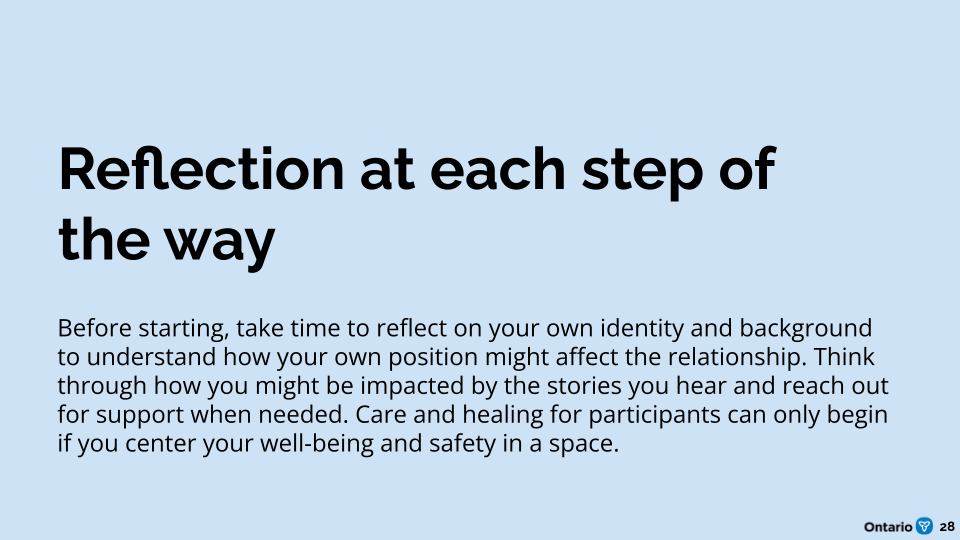
In December 2023, Ariana and I presented lessons learned from our EDI research at the Ontario Public Service (OPS) Service Design Guild. I coordinated with Service Design Guild organizers to plan the session, set the agenda, and developed slides summarizing our learnings to support other staff in adopting trauma informed-research in their work.
Take a peek at some of the slides I worked on!

What our partners say

006: Reflections
Doing EDI research takes courage
It can be deeply vulnerable to open up your ministry to do Equity, Diversity, and Inclusion research. The EDI working group at the Ontario Ministry entrusted us as partners to engage their staff in this research, and to tell the stories and worked collaboratively with us to plan the research. We are grateful for the partnership, and recognize that we not have been able to do this work without their collaboration.
Balancing being a researcher and a counsellor
As researchers, a lot of our work requires balancing human needs and research needs. We have research questions we want to answer, but when you get into a session sometimes some of those may need to be pushed aside as we tend to the human before us, who is maybe sharing something that is highly personal and difficult.
Critical reflexivity at each step
As a budding researcher in my practice of trauma-informed research, I learned just how critical reflexivity is throughout the course of doing this work. By this, I mean thinking critically about how my personal identities connect and intersect with participants, and how my own background might interact with the nature of the work.
Self-care as a researcher
Care and healing for your participants and users can only begin if you center your wellbeing and safety in a space. Because of this, it is important to prepare strategies for coping and supports you can provide if you or a member of your team are triggered by stories that are shared. In our team, we took part in post-interview debriefs to decompress and chat about how were feeling openly, within a group of three people.
Next project

Seniors' Community Grants Application